Engineering for Extremes: Flexible Metal Hoses for Space Applications
Flexible metal hose assemblies are indispensable in modern aerospace engineering, enabling safe fluid and gas transfer under some of the harshest conditions imaginable. Space is the ultimate proving ground: temperatures range from incredibly cold to incredibly hot, vibrations rattle components, and pressure lines can reach up to 16,000 psi.
To meet these challenges, engineers must design components that maintain mechanical integrity, thermal stability, and leak-tight performance across a wide operating envelope. This requires careful material selection, precise manufacturing tolerances, and rigorous qualification testing. Every hose assembly must be engineered not just to function, but to survive and perform reliably in environments where redundancy is limited and repair is impossible.
Challenges in the Space Environment
Temperatures in space systems can swing from cryogenic lows (liquid hydrogen fuel is around -423
°F) to engine plume or re-entry adjacent highs well over 1,000
°F. Hoses must remain flexible and functional throughout this extreme temperature range. Materials like standard stainless-steel start to lose toughness at cryogenic temps and strength above ~1000
°F, so specialized alloys are needed.
In the vacuum of space, there is no external pressure and no convective cooling. The outgassing of materials can also be an issue. Hoses must be vacuum-compatible (no trapped gases or moisture) and often need reflective insulation to limit radiant heat exchange. A vacuum also means any leak will vent fluids instantly, so leak tightness is critical.
Many space fluid systems operate at very high pressures. For example, spacecraft coolant loops and launch vehicle hydraulics can run in the thousands of psi. Certain aerospace hoses are rated up to 5,000 psi for liquids and even 16,000 psi for gases. The act of launch or engine ignition imposes pressure surges that hoses must survive.
Launch and flight subject hoses to violent vibrations and dynamic motion. Rocket engines gimbal for thrust vector control, which requires flexible couplings in propellant lines to accommodate movement. Aerospace hoses must absorb engine vibrations and spacecraft movements without fatigue cracking. On orbit, thermal expansion and structural flexing also require hoses to absorb relative movement.
One of the toughest constraints in space is that components must work reliably for the duration of the entire mission. Repairs on spacecrafts are often extremely challenging or impossible.

Flexible Metal Hoses in Space Applications
Flexible metal hoses are found in numerous aerospace applications where their ability to bend and withstand extremes is vital.
Rockets use flexible hoses to connect propellant lines and pressurization systems that must accommodate movement and thermal expansion. For example, cryogenic propellant feed lines may incorporate flexible bellows or hoses near the engine interface to allow for engine gimbaling. These hoses carry liquid oxygen, liquid hydrogen, RP-1 kerosene, and other fuels. They must handle cryo temperatures and dynamic pressure loads during launch. Flexible sections are also used for pressurant lines and between stages where movement occurs at separation.
Human-rated spacecraft like capsules, space stations, or landers employ flexible metal hoses in Environmental Control and Life Support Systems. This includes hoses for thermal control, cabin air recirculation, and fuel or oxidizer transfer lines in spacecraft service modules. Because these are life-critical, such hoses often have fire-resistant construction and meet stringent aerospace standards.
Uncrewed spacecraft also utilize flex hoses. Satellite propulsion systems use small diameter metal hoses to route hydrazine or xenon propellants from tanks to thrusters while accommodating thermal expansion and any slight structural shifts. Fluid conveyance on orbital platforms, like large communication satellites, might include flexible sections to ease assembly and mitigate vibration from moving. In satellite thermal systems, flexible hoses allow linking heat-dissipation components despite temperature-induced length changes.
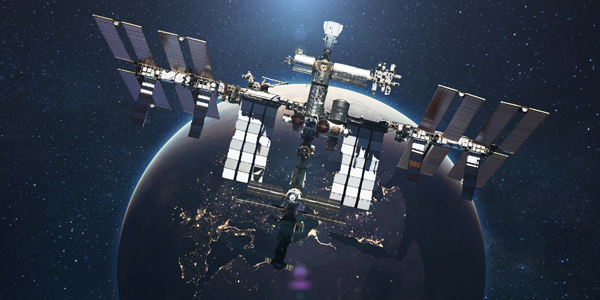
Engineering for Extremes
With such harsh conditions to consider, the engineers at FMH Aerospace employ advanced design techniques and select high-performance materials to ensure their hoses can withstand these extreme environments.
Inconel 625, a nickel-chromium superalloy, retains high strength at temperatures far beyond the limits of common steels. Stainless steel hoses have a practical upper service temperature of around 1000 °F before they significantly weaken. Inconel 625 can remain effective up to 1,800 °F (982 °C)7. This 80% higher temperature ceiling is crucial for rocket applications. Inconel also doesn’t creep or deform as much under prolonged heat and stress. At the cold end, austenitic alloys, like 300-series stainless or Inconel, also stay tough at cryogenic temperatures without becoming brittle. A NASA study evaluating alloys for flexible hoses in corrosive environments ranked Inconel 625 among the top performers.
Inconel 718 is a high-strength, corrosion-resistant nickel-chromium alloy known for its exceptional performance in extreme environments, including high temperatures and pressure. It offers excellent weldability, fatigue resistance, and stability under thermal cycling, making it ideal for aerospace and propulsion systems. At FMH, Inconel 718 is strategically utilized in the manufacturing of fluid conveyance and propellant lines, where durability, reliability, and resistance to oxidation and stress corrosion are critical. Its ability to maintain mechanical integrity under demanding conditions ensures safe and efficient operation across a wide range of mission profiles.
Space systems can involve corrosive fluids like oxidizers like nitrogen tetroxide, monopropellants like hydrazine, or cooling ammonia. Inconel is highly corrosion resistant, especially against chlorides and acids. This makes it ideal for long-term use where even minor corrosion could create leaks. Inconel also handles oxidation at high temperatures better than most steels, so it can survive hot oxygen-rich conditions, like an oxygen line that sees high heat.
Material selection also considers what the hose interfaces with. For example, if a hose connects to aluminum pipes, using stainless steel might cause galvanic corrosion in the presence of an electrolyte, using titanium or adding proper coating might be needed. Inconel is generally compatible with common aerospace metals and fluids, which is another reason for its use in these applications.
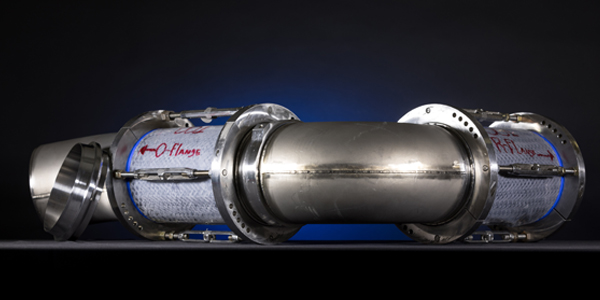
Testing for Reliability
Every flight hose assembly is typically pressure-tested well above its maximum operating pressure before it’s certified. A common practice is proof testing at 1.5x or 2x the working pressure. In critical applications, qualification units are pushed to burst to ensure a margin.
Achieving leak-tight performance is crucial, especially for toxic or scarce fluids in space. Hoses are often leak tested with helium mass spectrometer detection, which can sense extremely tiny leaks. FMH performs mass-spectrometer leak testing in-house – this is a where the hose is pressurized with helium and a detector checks for any escaping gas, ensuring even microscopic pinholes are caught. Acceptable leak rates are extremely low (often on the order of 1x10^-6 std cc/sec helium or tighter for propellants).
Critical hose components undergo Non-Destructive Examination techniques to ensure integrity. X-ray is used to inspect welds and the structure of the hose. This can reveal any incomplete penetration in welds or hidden cracks. Dye penetrant inspection is another method. A fluorescent dye is applied to detect surface cracks in welds or fittings. Only hoses that pass NDT proceed to final assembly.
Hoses are put on vibration tables or flex stands to simulate the motion and fatigue of a mission. A vibration test will shake the hose assembly at spectra representative of launch, often random vibration in multiple axes. The hose must not loosen, chafe, or develop leaks after vibration. Aerospace hose assemblies are often rated with a certain number of flex cycles. For instance, hoses might be cycled through expected movements thousands of times to verify longevity. The SAE AS1424 standard implicitly requires enduring aerospace vibration and thermal cycles.
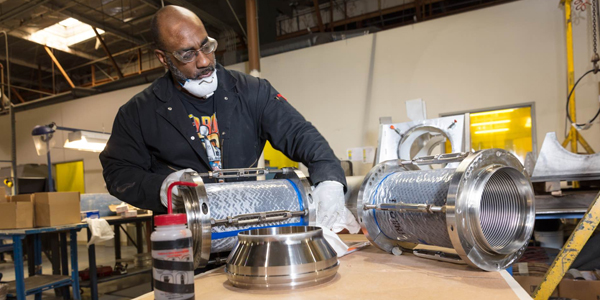
Custom Fabrication for Mission-Specific Requirements
Space systems rarely operate under uniform conditions. Each mission presents distinct thermal, mechanical, and integration challenges that standard components can’t always accommodate.
Custom fabrication allows hose assemblies to be engineered with the exact geometry, materials, and interface requirements needed for their specific environment. This includes accounting for routing constraints, pressure and temperature profiles, and dynamic movement. By tailoring each assembly to its application, FMH ensures that performance and reliability are maintained for every application.